
Learn · Part 4 of 4
Why Breathing Comes Before Tongue and Jaw Function
Before asking the muscles of the mouth, tongue, and jaw to change, we need to understand the conditions in which they are working.
The Body Works as a Connected System
Your tongue does not function in isolation. Neither does your jaw, diaphragm, neck, or airway.
These structures participate in a coordinated system that supports breathing, swallowing, speaking, eating, and posture. When one part of that system is working harder than it should, other muscles may adapt to help.
These adaptations are called compensations. They develop for a reason, often helping the body maintain stability, protect vulnerable areas, or accomplish a task when another structure or muscle is unable to function effectively.
Over time, these compensations can become established patterns of movement and tension. Although they may no longer be ideal, the body may still rely on them to feel stable and supported.
If we remove a compensation too quickly or introduce abrupt changes before the body has developed another way to maintain stability, it may respond by increasing tension and bracing elsewhere.
This is why we work gradually, helping the body develop new skills and sources of support before asking it to let go of familiar patterns.
Before we ask a muscle to work differently, we need to understand what it has been working around and what the body may need in order to feel supported without it.
The diaphragm does more than help you breathe
The diaphragm is a large, dome shaped muscle beneath your lungs. It is the primary muscle responsible for drawing air into the lungs during quiet breathing.
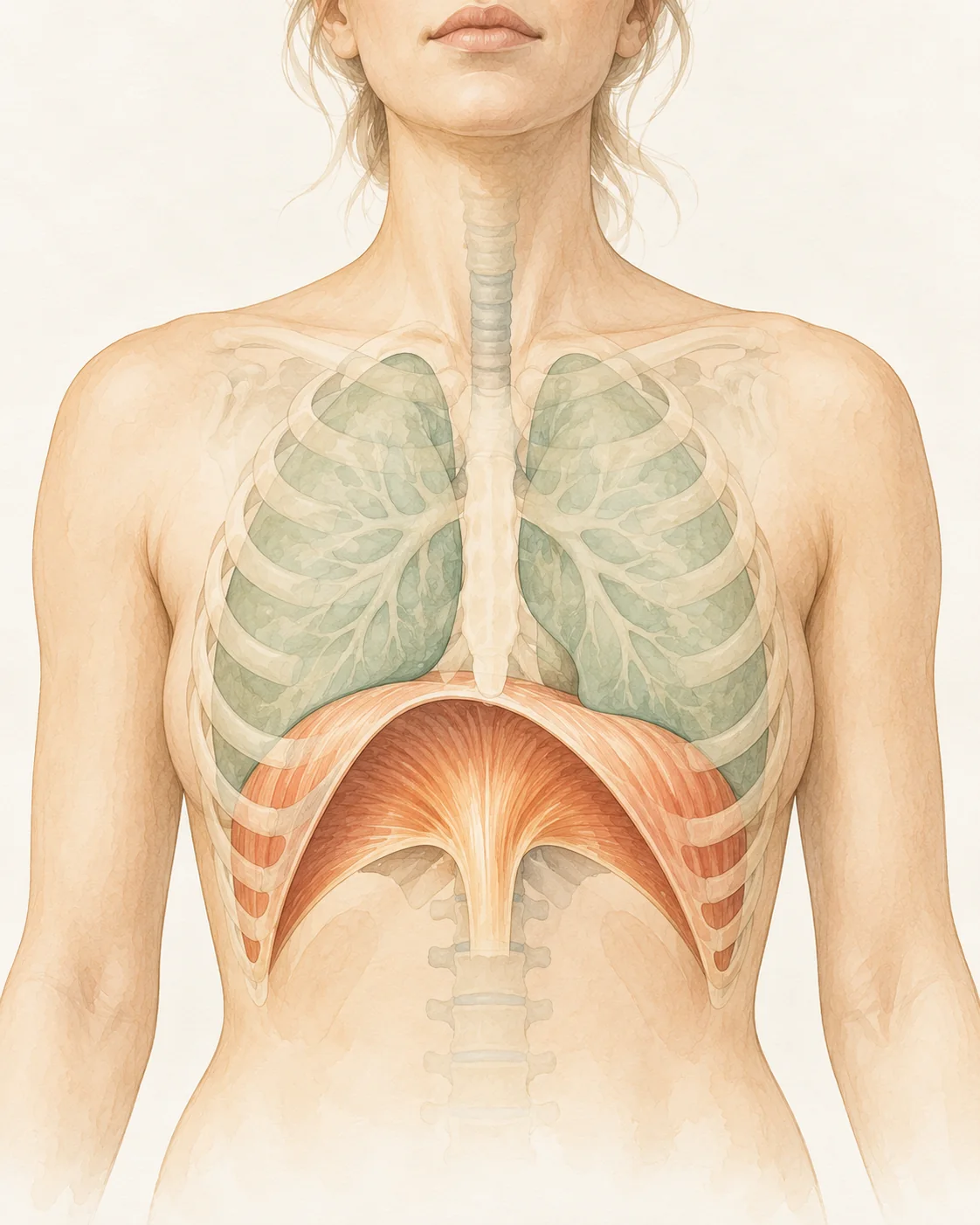
As it contracts, it moves downward, helping the lungs expand while the rib cage moves in coordination. The diaphragm also participates in the regulation of pressure within the abdomen and contributes to trunk stability.
Its movement works alongside the abdominal muscles, pelvic floor, and muscles surrounding the spine. When breathing mechanics become inefficient, the body may recruit additional muscles to assist.
This can contribute to increased effort through the neck, shoulders, and upper chest.
Learning to coordinate the diaphragm and rib cage can help reduce unnecessary effort and support more adaptable breathing.
Good breathing mechanics are only part of the picture
It is possible to move the diaphragm well and still breathe more air than your body needs. That is why we consider both breathing mechanics and respiratory chemistry.
The diaphragm helps determine how air moves. Carbon dioxide regulation helps us understand whether the amount of breathing is appropriate for the body's metabolic needs.
Both matter. A person may need help coordinating their breathing muscles, reducing unnecessary breathing effort, or recognizing habits that alter carbon dioxide levels.
Our goal is not simply diaphragmatic breathing. It is comfortable, coordinated breathing that meets the body's needs.
Why This Matters for the Tongue and Jaw
The muscles of the tongue, jaw, lips, and throat work closely with the structures involved in breathing and swallowing. If someone struggles to breathe comfortably through the nose, maintaining closed lips and a relaxed tongue resting position may be difficult.
If the neck and jaw are frequently recruited to assist with breathing or stabilization, these patterns may influence how oral exercises are performed. And if a person habitually holds their breath or uses excessive effort during movement, those habits may appear during tongue and jaw exercises as well.
This may help explain why some individuals struggle to make lasting progress with myofunctional therapy, even when they practice their exercises consistently.
If breathing mechanics remain inefficient or respiratory chemistry contributes to increased nerve and muscle excitability, the body may continue to rely on tension and compensatory patterns. Asking the tongue and jaw to relax or move differently can be challenging when the surrounding system is still working to maintain stability.
We want to recognize these relationships rather than train a new movement on top of an existing compensation.
Preparing for Myofunctional Therapy
Orofacial myofunctional therapy helps develop awareness, strength when needed, coordination, and appropriate patterns of muscle use. But before progressing through exercises, it is useful to understand how the person breathes at rest and whether they can perform movements without unnecessary tension or breath holding.
Myofunctional exercises can improve specific skills, but they may not fully address the breathing behaviors and physiological conditions contributing to persistent muscular tension.
By addressing breathing mechanics and respiratory chemistry alongside oral muscle function, we can help create more favorable conditions for learning new movements, reducing unnecessary tension, and integrating these skills into everyday life.
For some clients, breathing behavior training is an important first step. For others, breathing and myofunctional therapy can progress together. The sequence depends on the individual's assessment.
We are not simply teaching the tongue where to go. We are helping the body develop the conditions that allow it to function there comfortably.
What about Tongue Tie and the Importance of Timing a Release?
The tongue is connected to more than the mouth
A tongue tie occurs when the tissue beneath the tongue, called the lingual frenulum, restricts its movement or interferes with normal function.
Depending on the degree and nature of the restriction, a person may have difficulty elevating, narrowing, or coordinating the tongue. This can influence tongue resting posture, swallowing, oral muscle coordination, and the ability to perform certain movements without compensating with the jaw or facial muscles.
But the tongue does not function independently of the rest of the body.
Understanding the Deep Front Line
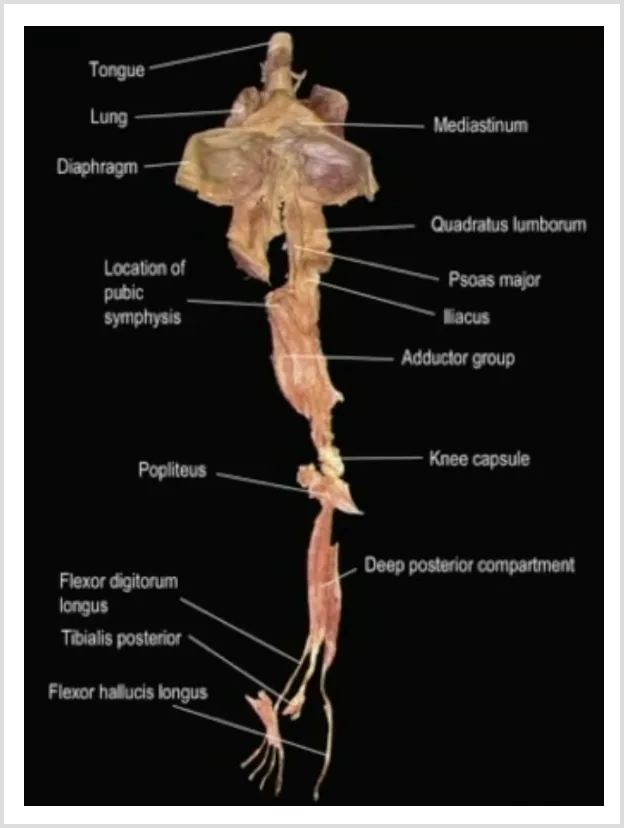
The Deep Front Line is a concept developed by Thomas Myers in Anatomy Trains. It describes a network of muscles and connective tissues, called fascia, that extends through the deeper structures of the body.
This model helps us visualize relationships between the tongue and throat, neck, respiratory diaphragm, deep abdominal muscles, pelvic floor, hips, legs, and feet.
These structures participate in important functions, including breathing, posture, movement, and stability.
For example, the diaphragm and pelvic floor work together to manage pressure within the trunk. The tongue and muscles of the throat participate in swallowing and airway function. Muscles throughout the neck, trunk, and pelvis coordinate to support posture and movement.
Although these structures perform different jobs, they are part of a body that must continually coordinate breathing, movement, and stability.
When tongue movement is restricted, some individuals may recruit additional muscles of the jaw, face, and neck to accomplish everyday tasks.
We may also observe changes in breathing mechanics, trunk stabilization, pelvic floor coordination, or gait. These findings deserve thoughtful assessment, although they cannot automatically be attributed to the tongue restriction.
The Deep Front Line provides a useful way to explore these relationships, but it does not establish that a restriction beneath the tongue directly causes dysfunction throughout the entire body.
What happens during a tongue tie release?
A tongue tie release is a surgical procedure that modifies the restrictive tissue beneath the tongue to improve its freedom of movement.
Two procedures you may hear about are:
- Frenectomy: A procedure that removes or releases restrictive frenulum tissue.
- Functional frenuloplasty: A deeper surgical approach that releases restrictive tissue into the midbody of the tongue and may involve repositioning and suturing the tissue to support healing and mobility.
The appropriate procedure depends on the individual's anatomy, functional limitations, age, and the surgeon's evaluation.
Although surgery may improve the tongue's available range of motion, greater mobility does not automatically create better function.
The tongue must still learn how to use that movement during resting posture, swallowing, speaking, and other everyday activities.
Why preparation before surgery matters
Over time, the body may develop compensations to work around restricted tongue movement.
The jaw may shift, the lips and cheeks may tighten, or the neck may become involved in movements that should require less effort.
These compensations developed for a reason. They helped the body accomplish a task despite a limitation.
If restricted tissue is released before the person has developed sufficient awareness, coordination, and alternative movement strategies, they may struggle to use their new range of motion comfortably.
This is why we place importance on preparation.
Before surgery, our work may focus on:
- Establishing comfortable nasal breathing when anatomically possible.
- Improving diaphragmatic breathing mechanics and respiratory chemistry.
- Reducing unnecessary tension in the face, jaw, and neck.
- Developing tongue mobility, narrowing, and elevation.
- Learning to maintain gentle tongue suction against the palate.
- Improving swallowing coordination and reducing compensatory movements.
- Developing comfort with oral touch, movement, and exercises.
These skills help us understand what the tongue can already do, what limitations remain, and whether surgery is likely to provide a meaningful functional benefit.
Why the timing of surgery matters
A tongue tie release should not be viewed as a race to remove restricted tissue.
Sometimes a person makes meaningful improvements in tongue mobility and oral function through therapy alone. In those cases, the need for surgery may deserve reconsideration.
For others, a restriction remains despite appropriate preparation, and surgical evaluation may be a reasonable next step.
When surgery is indicated, we want the person to have sufficient skills and support to participate in rehabilitation.
The procedure also requires time for healing. Depending on the surgical approach, this may involve temporary discomfort, swelling, dietary modifications, reduced activity, and specific postoperative care.
Planning ahead allows space for recovery and appropriate follow up with the surgeon and therapy team.
The goal is not simply to release tissue. It is to help the person make meaningful use of the movement that becomes available.
Supporting function after release
Healing involves more than the surgical site.
After a release, the tongue may have access to movements that were previously limited, but familiar patterns of swallowing, resting posture, and muscular compensation may still be present.
Postoperative myofunctional therapy helps develop coordination, awareness, and integration of these movements into everyday function.
Any wound care, stretching, or postoperative exercises must follow the operating surgeon's specific instructions.
We also continue to consider breathing mechanics, oral resting posture, and the ways the jaw and surrounding muscles participate in movement.
A successful plan considers the preparation, the procedure, and the rehabilitation that follows.
Not every tongue tie requires surgery, and not every person needs the same preparation or treatment sequence.
What matters is understanding the individual's anatomy, functional abilities, compensations, and readiness before deciding how to proceed.
We want to give the body an opportunity to develop new skills and support before asking it to adapt to a structural change.
Capacity before complexity
It can be tempting to focus on the most visible limitation first. But meaningful progress often begins with understanding the body's current abilities.
- Can the person breathe comfortably?
- Can they coordinate movement without excessive effort?
- Can they recognize tension and allow it to soften?
- Can they perform a simple movement consistently before progressing to a more complex one?
These questions guide how we approach therapy.
We begin with what the body can do, build upon that capacity, and introduce greater complexity when it is ready.
Breathe effortlessly. Be well. · Laura Barlow, CBBA, CSOM, INHC